Future-Proofing the Lab: Implementing Modular Workbenches for Rapid Protocol Scaling
The modern laboratory landscape in 2026 demands unprecedented spatial agility. As clinical diagnostic volumes fluctuate and R&D cycles compress, the traditional model of fixed, bolted-down casework has become a primary bottleneck to institutional growth. Implementing a modular infrastructure allows facility managers to pivot floor plans from high-throughput testing to specialized research in hours rather than weeks, ensuring that physical constraints never dictate scientific outcomes.
The Engineering of Agility: SEFA 10 Standards
The transition toward modularity is governed by the Scientific Equipment and Furniture Association (SEFA) 10 standards, which define the requirements for adaptable laboratory systems. Unlike conventional furniture, modular Workbenches are engineered as self-supporting structures that do not rely on wall attachment for lateral stability. This independence is critical for rapid protocol scaling, where benches must be rearranged to accommodate new automated liquid handlers or robotic analyzers.
Compliance with SEFA 10 ensures that the "quick-connect" utility interfaces for data, power, and gas remain secure during frequent reconfigurations. For facilities maintaining ISO 15189 accreditation, this modularity supports continuous quality improvement by allowing the optimization of workflow "spaghetti diagrams" without necessitating a total facility shutdown. The integration of heavy-duty Lab Carts & Transport systems further extends this agility, enabling the movement of sensitive instrumentation between workstations without recalibration risks.
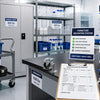
 Ideal configuration: A SEFA 10 compliant modular workstation featuring height-adjustable work surfaces and overhead utility carriers.
Surface Science: Epoxy vs. Phenolic Resin
Selecting the correct work surface is a critical decision in the engineering of a future-proof lab. Under SEFA 3 guidelines, the two primary contenders for high-performance environments are Epoxy Resin and Phenolic Resin. Epoxy resin is the gold standard for labs involving extreme heat or open flames, offering a monolithic structure that is impervious to most corrosive chemicals. Its density makes it an excellent choice for permanent heavy-load areas.
Conversely, Phenolic resin is increasingly favored for modular R&D labs due to its superior impact resistance and antimicrobial properties. It is significantly lighter than epoxy, which reduces the total dead weight on mobile frames, facilitating easier movement. When managing complex sampling protocols, the use of Lab Utility Trays on these surfaces provides an additional layer of secondary containment, essential for meeting OSHA laboratory safety standards (29 CFR 1910.1450).
Load-Bearing Dynamics and Instrumentation
A common failure point in modular design is underestimating the weight of modern analytical instrumentation. High-performance liquid chromatography (HPLC) units and mass spectrometers can exert significant point loads. Future-proof Workbenches must be rated for a minimum static load-bearing capacity of 1,000 lbs. To meet SEFA 8-M (Metal Casework) standards, these frames undergo rigorous cycle testing, including 2,000-cycle drawer and door tests, to simulate decades of use in high-throughput environments.
Vertical space optimization is equally vital. The implementation of Storage Cabinets & Shelving that integrate directly into the workbench uprights allows for the storage of consumables directly above the point of use. This reduces technician fatigue and minimizes the risk of cross-contamination by keeping the primary work zone clear of clutter.
 Precision storage: High-capacity shelving systems designed to maximize vertical footprint while maintaining ANSI safety clearances.
Integrating Utilities and Ventilation
For a lab floor plan to pivot in hours, the utility infrastructure must be decoupled from the walls. Overhead service carriers provide "plug-and-play" access to vacuum, compressed air, and specialized gases. This approach aligns with ANSI/ASSP Z9.5 standards for laboratory ventilation, ensuring that even when benches move, the airflow dynamics and local exhaust ventilation (LEV) systems remain effective. Utilizing mobile workstations allows for the rapid deployment of bench-top fume hoods or snorkel exhausts as protocol shifts from non-hazardous diagnostic sorting to volatile chemical synthesis.
ROI Analysis: Modular vs. Fixed Casework
While the initial capital expenditure for modular systems may be 15-20% higher than fixed casework, the long-term Return on Investment (ROI) is significantly greater. Fixed furniture often results in "stranded assets"—benches that cannot be moved and must be demolished during renovations. Modular systems, categorized as equipment rather than real property, often qualify for accelerated depreciation, providing immediate fiscal benefits for the procurement officer.
| Feature | Fixed Casework | Modular Workstations | Impact on Scalability |
|---|---|---|---|
| Reconfiguration Time | 3–6 Weeks (Construction) | 2–4 Hours (Manual) | Critical for R&D pivots |
| SEFA Compliance | SEFA 8 (Standard) | SEFA 10 (Adaptable) | Superior mobility |
| Load Capacity | High (Fixed) | 1,000+ lbs (Reinforced) | Matches modern instrumentation |
| Utility Access | Wall-dependent | Overhead/Plug-and-play | Enables center-room clusters |
Frequently Asked Questions
- How does modularity affect vibration-sensitive equipment? Many modular Workbenches are now engineered with dampening materials and heavy-gauge steel that meet or exceed the stability of fixed casework, making them suitable for microscopy and analytical balances.
- Are modular systems compliant with BSL-2 and BSL-3 requirements? Yes. When configured with non-porous surfaces like Epoxy resin and seamless Storage Cabinets & Shelving, these systems meet all requirements for sterilization and decontamination protocols.
- Can I integrate existing utilities into a modular floor plan? Yes, provided you implement overhead service drops. This allows you to utilize Lab Utility Trays and mobile Lab Carts & Transport units to bring the work to the utilities, rather than the other way around.
To remain competitive in 2026, lab managers must move away from the "static lab" mindset. A comprehensive audit of your current facility should focus on three steps: first, identify "dead zones" occupied by underutilized fixed benches; second, evaluate your current utility density versus your 24-month growth projections; and third, begin the phased replacement of fixed casework with SEFA 10 compliant modular systems. The ability to scale is no longer a luxury; it is a fundamental requirement of modern science.
-
Posted in
Furniture & Facility