Contamination Boundary Control: Validating Cleanroom Mats for Particle Capture, Footborne Transfer, and Gowning-Zone Efficiency
Contamination control is most vulnerable at transition points: doorways, gowning areas, airlocks, receiving corridors, and entrances to controlled rooms. Modern laboratories cannot rely on cleanroom classification alone if personnel, carts, shoes, and packaging materials move particles across uncontrolled boundaries. Cleanroom mats and lab entrance mats should be treated as contamination-control infrastructure, not housekeeping accessories. A validated mat program helps lab managers reduce footborne transfer, document boundary performance, and align facility traffic patterns with current standards for controlled laboratory operations.
Contamination Boundary Risk at Lab Entrances
Particles rarely respect room boundaries. They move on shoes, cart wheels, stool casters, packaging, garments, and cleaning tools. A laboratory may maintain excellent bench practices while still allowing uncontrolled particle transfer at the room entrance. This is why Lab Consumables & Cleaning should be evaluated as part of the contamination-control strategy, not only as replenishment supplies.
Cleanroom mats serve as a boundary device. They remove particles from footwear and wheels before personnel or materials enter a cleaner zone. In the best programs, mats support a defined transition: uncontrolled corridor to gowning zone, gowning zone to controlled room, or receiving area to clean staging. In weak programs, mats sit near a doorway without documented placement logic, replacement frequency, or performance monitoring. That creates a false sense of control while particles continue to bypass the mat.
Footborne contamination can affect cell culture work, diagnostic preparation, electronics-adjacent workflows, optical inspection, sterile assembly, microbiology, packaging, and environmental monitoring programs. A particle that enters on a shoe may later transfer to a cart wheel, glove, bench surface, or open container. The contamination route is often indirect, which makes the entrance boundary a high-value control point.
Why Mats Must Be Validated, Not Merely Installed
A mat is only effective if personnel and carts use it correctly, if the adhesive or surface remains active, and if placement forces enough contact steps before entry. A mat placed beside a door can be bypassed. A mat placed too close to a turn may receive only partial foot contact. A mat that is saturated with particles loses capture efficiency. A mat that curls at the edge becomes a trip hazard and may encourage staff to step around it.
Validation does not require excessive complexity. It requires documented intent, proper placement, defined change frequency, visual inspection, personnel training, and periodic review of environmental or housekeeping data. The purchasing decision should support the workflow, not only the product size or price.
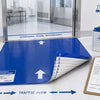
 A cleanroom entrance showing adhesive cleanroom mats, marked traffic direction, gowning-zone boundary labels, cart-wheel contact area, and a contamination-control checklist for mat placement and layer-change documentation.
 ISO 14644 Principles and Cleanroom Mat Validation
ISO 14644 cleanroom principles focus on airborne particulate control, cleanroom classification, monitoring, and clean operations. While a cleanroom mat is not a substitute for air filtration, pressure control, cleaning, gowning, or personnel discipline, it supports the same objective: controlling particle introduction into cleaner spaces. A mat program should therefore be connected to the facility’s contamination-control plan, room classification, traffic flow, cleaning frequency, and environmental monitoring strategy.
The key principle is boundary control. A cleaner area should have a defined transition point where personnel and materials change state before entry. That may include gowning, hand hygiene, shoe covers, cart wipe-down, packaging removal, or mat contact. Cleanroom mats are most effective when they are part of this sequence rather than an isolated floor product.
From Cleanroom Classification to Entrance Control
A cleanroom classification describes airborne particle limits under defined conditions. It does not automatically prove that all movement into the room is controlled. Personnel can introduce particles through clothing, footwear, hair, tools, paper, cardboard, and carts. Even a well-classified room can experience localized contamination if transition controls are weak.
Mat validation should therefore ask practical questions. Does every person step fully on the mat before entry? Do carts travel across the mat with all wheels contacting the surface? Does the mat length provide enough footfalls or wheel rotations? Are layers removed before the adhesive surface becomes overloaded? Are mats protected during cleaning, construction, deliveries, or high-traffic events?
Risk-Based Placement by Room Function
Not every lab entrance needs the same mat specification. A general research corridor, controlled sample preparation room, tissue culture entry, ISO-classified cleanroom, receiving area, and gowning room have different risks. High-control zones require stronger placement discipline, more frequent inspection, and tighter documentation. Lower-control zones may use mats primarily to reduce visible soil, dust, and general particle migration.
The mat program should rank locations by contamination consequence. A mat protecting a tissue culture room or clean assembly area is more critical than a mat near a general stockroom. Ranking allows procurement teams to assign premium adhesive mats to high-risk boundaries while using standard lab mats in lower-risk areas.
Particle Capture, Tack Retention, and Layer-Change Frequency
Cleanroom & Lab Mats function by capturing or retaining particles from shoe soles, wheels, and contact surfaces. Adhesive cleanroom mats use tacky layers that trap particles on contact. Non-adhesive lab entrance mats may use surface texture, fibers, or polymer structures to reduce tracked-in debris. The correct choice depends on the room risk, traffic level, particle-control objective, cleaning method, and replacement workflow.
The most important performance variable is not the mat’s appearance when new. It is how long the surface remains effective under actual traffic. Tack retention declines as particles accumulate, as moisture or powders load the surface, or as repeated wheel traffic compresses the adhesive. A mat that looks clean may still have reduced capture performance if the active surface is saturated or contaminated with residues.
Layer-Change Frequency as a Process Control
Adhesive mats typically use removable layers. Each layer provides a fresh capture surface when the contaminated layer is removed. The layer-change frequency should be based on traffic volume, contamination load, room risk, and visual inspection—not only a fixed calendar interval. A low-traffic gowning room may require fewer changes than a busy receiving entrance, but the high-risk room may still require stricter documentation.
A good procedure defines the trigger for changing a layer. Triggers may include visible particle loading, loss of tack, shift change, batch change, spill event, cart traffic event, end of day, or environmental monitoring excursion. Staff should record layer changes in a simple log when the mat protects a controlled zone. The log does not need to be complex; it should identify location, date, time, layer number where applicable, reason for change, and initials.
Footfall and Wheel Contact Requirements
Mat length and placement should support enough contact events to remove particles before entry. A mat that allows only one partial step may provide limited control. For personnel entry, the layout should encourage multiple full foot contacts. For carts, the mat should be long enough for wheel rotation and wide enough to capture all wheel paths. If staff must turn sharply at the entrance, mat placement should cover the actual turn path, not only the doorway centerline.
Labs should observe real traffic patterns before final placement. Operators may approach from one side, push carts at an angle, or avoid a mat if it interferes with doors. Validation should reflect actual behavior. Floor markings, directional labels, and physical layout changes can improve compliance.
Mat Placement, Traffic Flow, and Gowning-Zone Efficiency
A cleanroom mat is most effective when it supports a logical transition sequence. Personnel should encounter the mat at a point where they cannot reasonably bypass it. In gowning areas, mats should be placed between dirty and clean zones, often after initial shoe cleaning or before final entry depending on the gowning sequence. In material transfer areas, mats should capture wheel and package contact before items enter clean staging.
The mat should not create congestion. If a mat is placed where staff stop, pivot, or queue, it may load unevenly and become a bottleneck. If multiple people stand on the same small area, capture performance declines in that zone while other parts of the mat remain unused. The mat layout should guide movement through the boundary rather than interrupt it.
Gowning-Zone Efficiency
Gowning zones require strict sequencing. A poorly designed gowning area can force staff to step backward, cross dirty and clean paths, or place clean garments near contaminated footwear. Mats should reinforce the intended direction of movement. For example, the dirty side may include entry mat contact and outer shoe control, while the clean side may include final gowning checks before room entry.
The mat program should be integrated with gowning benches, garment storage, waste bins, hand hygiene stations, mirrors, and signage. If staff must leave the mat path to reach gloves, shoe covers, or waste containers, the boundary may fail. Efficient layout reduces both contamination risk and operator frustration.
Cart and Material Transfer Paths
Carts introduce a different contamination profile from footwear. Wheels collect debris from larger floor areas and may carry particles into controlled spaces even when personnel follow gowning rules. A cart mat strategy should identify whether carts are cleaned, dedicated by zone, passed through transfer hatches, or rolled over adhesive mats. High-control workflows may require dedicated cleanroom carts or wheel cleaning before entry.
Mat selection for cart traffic should consider adhesive strength, film durability, wheel load, rolling resistance, and edge stability. If the adhesive surface is too aggressive, wheels may pull or wrinkle layers. If the mat is too weak, wheels may not transfer enough particles to the surface. Procurement should match mat type to expected traffic.
Materials, Adhesive Chemistry, and Chemical Resistance
Cleanroom mats and lab entrance mats use different material systems depending on intended function. Adhesive mats often use polyethylene film layers with pressure-sensitive adhesive surfaces. The film must remain flat, resist tearing during layer removal, and maintain adhesive performance under normal humidity and traffic. Backing adhesion must hold the mat to the floor without leaving unacceptable residue or shifting during use.
Non-adhesive lab mats may use rubber, vinyl, polyurethane, or engineered polymer surfaces. These materials can provide durability, cushioning, or debris capture, but they must be selected for cleanability and chemical compatibility. A mat that absorbs liquids, sheds fibers, or traps residues in deep texture may be unsuitable for controlled laboratory zones.
Adhesive Performance and Environmental Conditions
Adhesive tack can change with temperature, humidity, dust loading, moisture, and chemical residue. High humidity or wet footwear can reduce particle capture and create surface smearing. Very dry environments may increase static attraction but also influence film handling. Powder, fibers, and granular debris can saturate the surface quickly.
Procurement teams should evaluate layer count, adhesive strength, mat thickness, sheet removal tabs, backing stability, and compatibility with floor finishes. A mat that performs well in a low-traffic clean corridor may fail under wet receiving-area traffic. The purchasing file should define where each mat type is approved for use.
Chemical Exposure and Cleaning Compatibility
Lab mats may be exposed to disinfectants, alcohols, bleach solutions, detergents, solvent residues, buffer spills, or floor-cleaning chemicals. Adhesive mats are typically not cleaned in the same manner as permanent mats; contaminated layers are removed instead. Permanent mats require a cleaning method that removes residues without degrading the surface or causing slippage.
Chemical resistance should be evaluated by concentration, contact time, cleaning frequency, and drying method. Repeated exposure can cause swelling, embrittlement, tack loss, discoloration, surface cracking, or adhesive residue transfer. If a mat is installed in a spill-prone location, the SOP should define whether the mat is replaced, cleaned, or removed after exposure.
 An adhesive cleanroom mat at a gowning-zone boundary with numbered peel-off layers, particle inspection label, traffic-flow arrows, replacement mat layers, and a validation log documenting layer-change frequency.
 Monitoring, Documentation, and Procurement Control
A cleanroom mat program should include inspection, change logs, training, and periodic review. Inspection confirms that the mat is flat, active, positioned correctly, and not overloaded with particles. Change logs confirm that adhesive layers are removed before performance becomes questionable. Training confirms that staff understand the purpose of the mat and do not bypass it during routine work.
Monitoring can be simple or advanced depending on risk. Basic programs use visual checks and layer-change logs. Higher-control programs may correlate mat status with environmental monitoring data, viable particle trends, nonviable particle counts, cleaning observations, gowning audits, or contamination investigations. The mat program should support the facility’s contamination-control plan rather than exist as an isolated supply item.
Procurement Specifications for Cleanroom Mats
A technical purchase specification should include mat type, size, color, layer count, adhesive strength, backing adhesion, sheet numbering, tab design, compatibility with shoe covers, cart-wheel suitability, floor compatibility, and intended placement. For permanent mats, include material, thickness, edge profile, chemical resistance, cleanability, slip resistance, and replacement criteria.
Buyers should also consider operational details. Does the mat size fit the doorway and actual traffic path? Can staff remove layers without touching the adhesive surface? Does the color make contamination visible? Does the backing damage floor coatings? Does the mat create a trip hazard? Is the replacement supply standardized across all controlled entrances?
Training and Behavioral Controls
Even the best mat fails if personnel step around it. Training should specify how to cross the mat, when to change layers, what visible loading means, and how to report a damaged or shifting mat. Signage should be concise: step fully, roll carts straight across, do not bypass, remove top layer when loaded, and document changes when required.
Supervisors should periodically observe traffic. If staff consistently bypass the mat, the problem may be placement, workflow congestion, door swing, cart route, or mat size—not employee attention. Correcting the physical layout is often more effective than repeating reminders.
Cleanroom Mat Control Table
A risk-based approach helps labs assign the correct mat type and documentation level to each boundary. The table below provides a practical framework for procurement, validation, and ongoing monitoring.
| Boundary Type | Primary Contamination Risk | Recommended Mat Strategy | Validation Method | Documentation Requirement |
|---|---|---|---|---|
| General lab entrance | Tracked dust, floor debris, general particulate transfer | Lab entrance mat or contamination-control floor mat sized to doorway traffic | Visual inspection, housekeeping review, traffic observation | Routine cleaning or replacement record based on facility policy |
| Gowning-zone transition | Footborne particles entering cleaner side of gowning path | Adhesive cleanroom mat positioned at dirty-to-clean transition | Footfall observation, layer-change trigger verification, gowning audit | Layer-change log, location ID, staff training record |
| Cleanroom entry | Particles from footwear, shoe covers, and cart wheels entering controlled room | Adhesive mat with adequate length and width for full foot and wheel contact | Traffic-path validation, particle-trend correlation where applicable | Layer number, change frequency, inspection checklist, deviation notes |
| Material transfer area | Particles from boxes, carts, wheels, and packaging movement | Cart-compatible mat with defined wheel path and package staging control | Wheel contact observation, mat shift inspection, residue review | Cart-route SOP, mat inspection log, cleaning or layer-change record |
| High-load receiving or staging area | Heavy traffic, wet footwear, packaging debris, rapid surface loading | Durable lab mat plus adhesive mat at cleaner secondary boundary if needed | Traffic-volume review, visible loading trigger, replacement interval analysis | High-traffic maintenance log, replacement schedule, corrective action record |
FAQs
- Why should cleanroom mats be treated as contamination-control infrastructure? Cleanroom mats control particle movement at transition points where personnel, carts, and materials enter cleaner areas. If they are selected, placed, or changed casually, they may provide little real protection while creating the appearance of control.
- Where should adhesive cleanroom mats be placed? Adhesive mats should be placed where personnel or carts must pass fully across them before entering a cleaner zone. Common locations include gowning boundaries, cleanroom entrances, material transfer points, and controlled sample preparation rooms. Placement should reflect actual traffic patterns.
- How often should adhesive mat layers be changed? Layer-change frequency should be based on traffic volume, visible particle loading, tack loss, room risk, and defined events such as shift change, batch change, or spill exposure. High-risk entrances should have documented layer changes rather than informal replacement.
- Can a cleanroom mat replace gowning or cleaning procedures? No. Mats reduce particle transfer from shoes and wheels, but they do not replace gowning, hand hygiene, garment control, cart cleaning, room cleaning, pressure control, or environmental monitoring. They are one boundary-control component within a broader contamination-control system.
- What is tack retention? Tack retention describes the mat surface’s ability to remain sticky enough to capture particles over time and traffic. Tack can decline when the surface becomes loaded with particles, moisture, powders, or residues. Loss of tack should trigger layer removal or mat replacement.
- Are permanent lab mats suitable for cleanroom entrances? Permanent lab mats may be useful for general entrances or lower-risk areas, but high-control cleanroom entries often require adhesive mats because they provide removable particle-capture layers. The correct choice depends on classification, traffic, cleaning method, and contamination risk.
- Which LabCals categories support a cleanroom mat validation program? A controlled program should connect Lab Consumables & Cleaning with Cleanroom & Lab Mats so that adhesive cleanroom mats, lab entrance mats, and replacement mat layers are selected and documented by boundary risk.
Inventory and Protocol Audit
A practical audit begins with three actions. First, map every transition point where personnel, carts, tools, or materials move from a lower-control area into a cleaner zone, then assign each boundary a contamination-risk level. Second, verify that each mat is correctly sized, positioned, and documented with a defined inspection rule, layer-change trigger, and replacement supply. Third, lock approved Cleanroom & Lab Mats into the purchasing file so substitutions trigger review for adhesive performance, traffic suitability, floor compatibility, and documentation requirements. This gives lab managers a defensible path to reduce particle migration, improve gowning-zone efficiency, and align mat use with current standards for contamination-control operations.
-
Posted in
Safety & Consumables