Latent Defect Prevention: The Critical Role of ESD Shielding in Bio-Sensor and Semiconductor Storage
As we progress through 2026, the miniaturization of bio-sensors and the increasing complexity of wide-bandgap semiconductors have rendered traditional static control measures insufficient. The modern laboratory environment faces a silent predator: the latent defect, an invisible structural failure caused by Electrostatic Discharge (ESD) that allows a component to pass initial testing only to fail prematurely in the field. Understanding the physics of charge generation and the implementation of advanced shielding is no longer optional for institutional compliance; it is a fundamental requirement for product integrity and data reliability.
The Physics of Walking Body Voltage
The phenomenon known as "Walking Body Voltage" is a primary contributor to ESD events in the laboratory. As a technician moves across a non-conductive floor, the friction between their footwear and the surface causes triboelectric charging. In a dry environment, this movement can generate potential differences exceeding 15,000 volts. While this charge may be below the human threshold for feeling a "shock," it is more than enough to punch through the thin oxide layers of a bio-sensor or the gate dielectric of a field-effect transistor (FET).
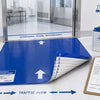
To mitigate this, laboratories must establish an Electrostatic Protected Area (EPA) where all conductive and dissipative elements are bonded to a common ground point. The use of ESD Floor Mats acts as a critical interface, providing a low-resistance path to ground that continually bleeds off the charge generated by foot traffic. Without these mats, a technician remains a mobile capacitor, carrying a charge that can discharge catastrophically upon contact with sensitive ESD Storage Containers or open semiconductor wafers.
 Analysis of voltage accumulation on the human body relative to humidity and flooring material, highlighting the necessity of continuous grounding in the EPA.
Material Science: Multi-Layer Antistatic Shielding
When sensitive components leave the EPA, they must be encased in a "Faraday Cage" to protect them from external electrostatic fields. This is achieved through the use of high-authority ESD Antistatic Bags. Unlike simple pink poly bags, which are merely anti-static (meaning they do not generate charge), true shielding bags utilize a multi-layer laminate structure. The core layer typically consists of a microscopic aluminum or nickel film that provides the physical "shielding" effect, encased between layers of dissipative polyester and polyethylene.
The material science behind these ESD Antistatic Bags ensures that even if a high-voltage probe touches the outside of the bag, the charge is conducted around the surface of the metallic layer rather than through the sensitive component inside. In 2026, standards such as ANSI/ESD S541 mandate that these bags maintain a surface resistance of less than $1 \times 10^{11} \Omega$ and provide a discharge shielding energy of less than 20 nanojoules. This level of protection is vital for bio-sensors, where even trace electrostatic fields can degrade the chemical functionalization of the sensor surface.
Grounding Infrastructure: Floor Mats and Wrist Straps
The bedrock of ESD safety is the continuous grounding of personnel. ESD Wrist Straps are the primary tool for this purpose. A high-quality wrist strap features a conductive interior cuff and a coil cord with a built-in 1-megohm resistor. This resistor is a critical safety feature; it is high enough to prevent a lethal current from passing through the technician in the event of an accidental contact with a live power source, but low enough to allow the static charge on the body to drain to ground in less than 0.1 seconds.
For technicians who must remain mobile within the lab, ESD Floor Mats combined with ESD-safe footwear or heel grounders provide the secondary path to ground. These mats are typically dual-layer: a dissipative top layer to drain the charge and a conductive bottom layer to bond to the ground. In 2026, facility managers must perform periodic "Compliance Verification" using surface resistance meters to ensure that the mats have not become fouled with non-conductive waxes or cleaners, which would render the grounding path ineffective.
 A comprehensive grounding diagram illustrating the 1-megohm safety resistor and the primary discharge paths for a technician working within an EPA.
Safe Storage Logistics and Rigid Containers
While flexible bags are ideal for transport, long-term storage of semiconductors and bio-chips often requires rigid ESD Storage Containers. These bins and totes are manufactured from conductive polymers, such as carbon-loaded polypropylene. Unlike surface coatings that can wear off, these containers have static-control properties integrated into the molecular structure of the plastic, providing permanent protection. They are designed to be stackable while maintaining electrical continuity between units, effectively creating a massive grounded storage matrix.
When organizing these containers, lab managers must ensure that non-ESD-safe materials (like standard plastic folders or Styrofoam) are strictly prohibited from the storage area. These "insulators" can hold a static charge for hours and cannot be grounded. If an insulator comes within 12 inches of a sensitive component, the resulting electrostatic field can induce a charge on the device even without direct contact—a phenomenon known as "Field Induction." Utilizing only verified ESD Storage Containers eliminates this risk by ensuring that every surface in the storage zone is dissipative.
2026 ANSI/ESD and ISO Compliance Frameworks
The regulatory landscape for ESD control in 2026 is defined by ANSI/ESD S20.20 and the updated ISO 9001:2026 requirements for electronic and medical device manufacturing. These standards require a written ESD Control Program Plan, including documented training for all personnel and a "Compliance Verification" log for all equipment. Specifically, ESD Wrist Straps must be tested daily, while ESD Floor Mats and ESD Storage Containers must be audited monthly using specialized megohmmeters.
| ESD Component | Material Construction | Required Surface Resistance | 2026 Compliance Standard |
|---|---|---|---|
| Antistatic Shielding Bags | Multi-layer Metalized Laminate | $10^4 \text{ to } 10^{11} \Omega$ | ANSI/ESD S541 |
| Wrist Straps | Conductive Fabric / 1M$\Omega$ Resistor | $< 3.5 \times 10^7 \Omega$ | ANSI/ESD S1.1 |
| Floor Mats | Dual-layer Dissipative Rubber | $10^6 \text{ to } 10^9 \Omega$ | ANSI/ESD S7.1 |
| Storage Containers | Carbon-loaded Polypropylene | $< 10^6 \Omega$ (Conductive) | ANSI/ESD S20.20 |
Frequently Asked Questions
- What is a latent defect and why is it so dangerous? A latent defect is a "wounded" component. The ESD event does not destroy the circuit immediately but creates a microscopic fracture or melt-track. Over time, under thermal and electrical stress, this flaw grows until the device fails in the customer's hands. This is why ESD Antistatic Bags are critical even if the device "works" after a discharge.
- Do ESD wrist straps expire? The conductive fibers in the cuff of ESD Wrist Straps can break or become insulated by skin oils over time. In 2026, it is standard practice to test your wrist strap every time you enter the EPA to ensure the resistance is within the safe $750 \text{ k}\Omega$ to $35 \text{ M}\Omega$ range.
- Can I use standard cleaners on my ESD floor mats? No. Standard cleaners contain silicones or waxes that create an insulative layer on top of the mat. You must use specialized ESD-safe cleaners that maintain the dissipative properties of your ESD Floor Mats.
- Are pink antistatic bags the same as silver shielding bags? No. Pink bags only prevent the generation of static (anti-static). They do not shield from external fields. For bio-sensors and semiconductors, you must use silver ESD Antistatic Bags to provide a Faraday cage.
Managing ESD in a 2026 laboratory environment requires a holistic approach that combines material science with rigorous protocol. A practical takeaway for any lab manager is to perform an immediate audit of their EPA: verify that ESD Wrist Straps are tested daily, confirm that ESD Floor Mats are properly grounded to a common point, and replace any single-layer "anti-static" bags with multi-layer metalized ESD Antistatic Bags. Furthermore, transitioning long-term storage into rigid ESD Storage Containers will provide permanent protection against the "Walking Body Voltage" that threatens your institutional reliability. Would you like me to develop a daily ESD testing log template for your facility's compliance records?
-
Posted in
Furniture & Facility