Optimizing Liquid Handling Reproducibility: The Role of Low-Retention Tech and Stand Calibration
In the ultra-sensitive analytical landscape of 2026, the margin for error in volumetric delivery has reached a critical bottleneck. As genomic and proteomic assays move toward microliter and nanoliter scales, the physical interaction between fluids and polymer surfaces dictates the success of institutional research. Achieving reproducible results now demands a holistic integration of advanced material science, rigorous mechanical maintenance, and standardized liquid handling protocols to eliminate the hidden variables of sample carryover.
Material Science: The Mechanics of Low-Retention Technology
The efficacy of liquid handling is fundamentally limited by the surface energy of the dispensing vessel. Traditional polypropylene tips possess inherent surface irregularities that lead to the "binding" of biological molecules and viscous liquids. In 2026, the industry has standardized on high-hydrophobicity Pipette Tips manufactured through diamond-finish molding. These low-retention tips utilize a modified polymer surface—often a blended fluoropolymer or a co-molded silicone additive—that reduces the coefficient of friction and prevents the formation of a liquid film on the internal wall.
Quantifying this performance requires an understanding of the contact angle. Standard tips typically exhibit a contact angle of approximately 90°, whereas advanced low-retention Pipette Tips achieve angles exceeding 120°. This prevents "beading" and ensures that the entire aspirated volume is dispensed, which is critical when handling detergents, high-viscosity buffers, or genomic samples where recovery is paramount. For less rigorous liquid transfers or non-critical reagents, Transfer Pipettes made from low-density polyethylene (LDPE) remain the standard, provided they are utilized within their calibrated temperature ranges to avoid thermal expansion errors.
 Scanning electron microscopy (SEM) reveals the surface uniformity of 2026-grade low-retention polymers, demonstrating zero-residue dispensing for aqueous and organic solvents.
Maintaining Volumetric Integrity via Controller Calibration
Precision dispensing is not solely a function of the consumable; it is a symbiotic relationship with the aspiration mechanism. Modern Pipette Controllers & Accessories utilize micro-stepping motors and pressure sensors to counteract atmospheric pressure variables. However, these electronic systems are subject to mechanical drift. ISO 8655:2026 standards now mandate gravimetric or photometric calibration every six months to ensure that the "systematic error" (inaccuracy) and "random error" (imprecision) remain within the permissible threshold.
Beyond electronic controllers, the physical storage of these instruments impacts their volumetric accuracy. Vertical storage on Pipette Stands & Holders is mandatory to prevent internal piston corrosion. When pipettes are left horizontally on a benchtop, residual vapors or liquids can migrate into the shaft, compromising the airtight seal. High-quality Pipette Stands & Holders are engineered with weighted bases and non-slip surfaces to ensure that instruments are accessible yet protected from the mechanical shocks that can knock a calibrated micrometer out of alignment.
Systematic Organization: Racks and Workflow Efficiency
In high-throughput environments, the risk of contamination often stems from disorganized consumables. Utilizing color-coded Pipette Tip Racks allows for rapid visual verification of tip volume and purity levels (e.g., sterile vs. non-sterile). Modern 2026-compliant racks are manufactured from high-grade polycarbonate that withstands repetitive autoclaving at 121°C without warping. This thermal stability is essential because even a minor deformation in the rack can lead to improper tip seating, resulting in air leaks during aspiration.
Implementing a systematic "empty-rack replacement" protocol prevents the accidental reuse of contaminated tips. For sensitive PCR or sequencing workflows, the use of hinged-lid Pipette Tip Racks prevents the settlement of airborne particulates and aerosolized DNA into the open tip orifices. When combined with the high-precision aspiration provided by high-end Pipette Controllers & Accessories, this organizational rigor ensures that the sterile chain of custody remains unbroken from the rack to the reaction plate.
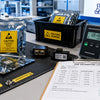
 A modern 2026 laboratory setup featuring ergonomic pipette stands and color-coded tip racks designed for maximum throughput and minimal cross-contamination.
2026 ISO Standards for Liquid Handling Compliance
Institutional compliance in 2026 is governed by updated ASTM and ISO protocols. Specifically, ASTM E1154 and ISO 8655 provide the definitive framework for "Piston-operated volumetric apparatus" (POVA). These standards categorize Pipette Tips as "integral components" of the pipette system; therefore, using third-party tips without verifying their fit can void a lab’s compliance status. Managers must ensure that the orifice diameter and seating depth of the Pipette Tips are precisely matched to the pipette’s nozzle to maintain the pressure differential required for accurate delivery.
Environmental conditions also play a critical role in 2026 compliance. Standards now require that liquid handling be performed at a constant temperature (typically 20°C to 25°C) and relative humidity () to minimize evaporation during the dispensing cycle. When using Transfer Pipettes for bulk reagent preparation, the liquid must be allowed to equilibrate to the ambient room temperature to prevent density-related volumetric discrepancies.
| Liquid Handling Category | Primary Material/Tech | Standard Precision Target | 2026 Compliance Standard |
|---|---|---|---|
| Low-Retention Tips | Diamond-Molded Polypropylene | <1% Residue Carryover | ISO 8655 / USP <1663> |
| Electronic Controllers | Micro-Stepping Piston Motor | ±0.5% Accuracy | ISO 17025 Calibration |
| Manual Transfer Pipettes | Inert LDPE | ±5% Volumetric Tolerance | ASTM E1270 |
| Sterile Tip Racks | Autoclavable Polycarbonate | ISO Class 5 Purity | EN ISO 11137 |
Protocol Optimization and Mechanical Longevity
The longevity of laboratory assets is directly tied to preventative maintenance. Pipette Controllers & Accessories require regular filter replacements to prevent liquid ingress into the internal electronics. If a filter becomes saturated, the resulting airflow resistance will lead to under-aspiration, a common but often undiagnosed source of experimental variance. Similarly, the friction points on manual pipettes should be lubricated with high-performance laboratory grease to ensure smooth piston movement and reduce user hand fatigue.
Finally, the transition from bulk-bagged tips to pre-racked systems is a major trend for 2026. While bulk Pipette Tips offer cost savings, the manual racking process introduces high risks of contamination and physical damage to the tip orifices. Professional Pipette Tip Racks are designed to support the tips at the shoulder, protecting the delicate distal end from contact. By investing in high-quality Pipette Stands & Holders and standardized consumables, lab managers can ensure that their technical staff spends more time on data generation and less time on troubleshooting inconsistent liquid handling results.
- Does autoclaving low-retention tips affect their performance? In 2026-grade polymers, the low-retention property is integrated into the polymer matrix rather than a surface coating. Therefore, autoclaving does not degrade the hydrophobic performance, though one must ensure the Pipette Tip Racks are rated for high-temperature cycles.
- Why should I use Pipette Stands & Holders instead of laying tools on the bench? Bench-top storage leads to contamination from work surfaces and allows liquid to seep into the internal piston. Vertical storage on Pipette Stands & Holders ensures that gravity pulls residual vapors away from the internal mechanisms.
- What is the difference between air-displacement and positive-displacement tips? Air-displacement tips (the standard for Pipette Tips) utilize an air cushion between the liquid and piston. Positive-displacement systems, often used in specialized Pipette Controllers & Accessories, use a physical piston in the tip itself, making them ideal for high-viscosity or volatile liquids.
- How often do Transfer Pipettes need calibration? Standard Transfer Pipettes are typically intended for single-use and are non-adjustable. Their accuracy is guaranteed at the time of manufacture to a specific tolerance, but they should never be used for quantitative analytical chemistry.
Optimizing your lab's liquid handling for the coming year requires a dual focus on material science and mechanical rigor. Start by auditing your consumable inventory for 2026-grade low-retention Pipette Tips and ensuring all Pipette Tip Racks are compatible with your automation or manual workflows. Conclude your audit by verifying the calibration status of all Pipette Controllers & Accessories and ensuring every pipette has a dedicated position on a vertical stand. This systematic approach will secure your reproducibility and protect your high-value samples. Would you like me to help you develop a customized calibration schedule for your laboratory's specific instrument fleet?
-
Posted in
Liquid Handling & Filtration