The Invisible Threat: Why Your Lab Needs a Comprehensive ESD Protection Plan
In the hyper-connected laboratory landscape of 2026, the miniaturization of sensitive analytical components and the rise of high-fidelity genomic sequencing have rendered Electrostatic Discharge (ESD) a critical threat to data integrity and hardware longevity. As laboratories increasingly deploy advanced robotics and sub-micron diagnostic sensors, the management of triboelectric charging is no longer a peripheral concern but a fundamental requirement for institutional compliance. Adhering to the updated 2026 ANSI/ESD S20.20 standards is essential to mitigate latent failures that can invalidate months of research or cause catastrophic failure in expensive instrumentation.
The Physics of Triboelectric Charging in the Lab
Electrostatic discharge occurs when two materials come into contact and then separate, resulting in a transfer of electrons. This phenomenon, known as triboelectric charging, can generate thousands of volts on a human operator or a plastic surface. While a human might not feel a discharge below 3,000 volts, modern laboratory components—especially those utilized in nanotechnology and semiconductor-based diagnostics—can be permanently damaged by charges as low as 10 to 30 volts. In 2026, the complexity of these latent failures is particularly dangerous; a component may not fail immediately but may exhibit "walking wounded" symptoms, leading to erratic data and drift in analytical results.
The laboratory environment inherently promotes static generation through low humidity (often maintained for sample stability) and the use of synthetic materials in lab coats and gloves. Without a dedicated pathway to ground, these charges accumulate on surfaces and personnel. A comprehensive ESD protection plan (EPP) ensures that all conductive and dissipative elements are linked to a common point ground, effectively draining charge at a controlled rate to prevent rapid, high-current sparks that cause thermal damage to microscopic circuits.
 Figure 1: Microscopic view of a latent ESD failure in a diagnostic sensor, showing thermal pitting that compromises 2026 research accuracy.
Personal Grounding: The First Line of Defense
Personnel are the most significant source of static generation in the workplace. As technicians move across the floor or handle plastic consumables, they act as mobile capacitors. To neutralize this risk, the implementation of ESD Wrist Straps is mandatory for any task involving open instrumentation or the handling of sensitive PCBs. Modern ESD Wrist Straps in 2026 utilize silver-infused conductive fibers that ensure constant skin contact without the irritation associated with legacy stainless steel designs.
The technical efficacy of ESD Wrist Straps depends on the integrity of the 1-megohm resistor embedded in the ground cord. This resistor is a critical safety feature; it is large enough to bleed off static electricity safely but high enough to protect the user from electrical shock in the event of contact with mains voltage. Under 2026 ISO 9001 and ANSI protocols, these straps must be tested daily using a dedicated station to ensure the path to ground remains within the 750k to 35M ohm range. Failure to maintain these grounding systems can lead to unmonitored charge accumulation, bypassing the institutional safety hierarchy.
Stationary Protection: Surface and Floor Engineering
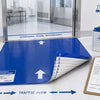
While personal grounding handles the operator, the laboratory environment itself must be engineered to be dissipative. This is achieved through the deployment of ESD Floor Mats. Unlike standard rubber mats, ESD Floor Mats are constructed with a conductive buried layer or a dissipative top layer that provides a controlled resistance to ground. These mats are essential in areas where technicians are standing for long periods or where mobile equipment—such as 304-grade stainless steel carts—is utilized.
In 2026, the material science of ESD Floor Mats has evolved to focus on chemical resistance and outgassing. High-performance mats must withstand the phenolic disinfectants and 70% IPA commonly used in sanitization protocols without losing their dissipative properties. Furthermore, these mats must comply with ASTM F150 for electrical resistance, ensuring that any charge introduced by footwear or equipment wheels is drained in less than 0.1 seconds. This rapid decay time is vital for preventing the induction of charges on nearby samples or micro-pipetting systems that could alter liquid handling precision.
Secure Transport: Antistatic Bags and Containers
The danger of ESD does not vanish when a component or sample leaves the workbench. Static-sensitive items are most vulnerable during transport through uncontrolled zones of the facility. To address this, ESD Antistatic Bags provide a Faraday cage effect. These multi-layer bags typically feature a metallic shield layer sandwiched between dissipative polyester and polyethylene. This construction prevents external static fields from penetrating the bag and protects the contents from direct discharge if handled by an ungrounded person.
For organized laboratory storage and high-volume movement, ESD Storage Containers are required. These containers are molded from carbon-loaded or inherently dissipative polymers that provide permanent protection, unlike temporary topical sprays. In 2026, ESD Storage Containers are often integrated into automated retrieval systems, where the friction of the mechanical arms could otherwise generate significant static. Utilizing ESD Antistatic Bags in conjunction with these ESD Storage Containers creates a redundant protection system that meets the most stringent 2026 MIL-STD and ISO cleanroom requirements.
 Figure 2: Comprehensive transport protection utilizing multi-layer ESD Antistatic Bags and high-density ESD Storage Containers.
2026 Standards & Performance Matrix
| ESD Tool/Consumable | Primary Material Science | 2026 Regulatory Standard | Target Resistance (Rtg/Rpp) |
|---|---|---|---|
| ESD Wrist Straps | Silver/Conductive Fiber | ANSI/ESD S1.1 | 1 x 10^6 ohms |
| ESD Floor Mats | Dissipative Nitrile Rubber | ASTM F150 / S7.1 | 1 x 10^6 to 1 x 10^9 ohms |
| ESD Antistatic Bags | Metalized Polyester/PE | MIL-PRF-81705E | < 50 nJ Energy Penetration |
| ESD Storage Containers | Carbon-Loaded Polypropylene | ANSI/ESD S541 | < 1 x 10^11 ohms |
Frequently Asked Questions
- Question: Can I use standard plastic bins for storage if I keep the room humid? While humidity helps reduce static generation, it is not a substitute for ESD controls. In 2026, high-precision labs must use ESD Storage Containers because specialized resins provide a predictable discharge path that humidity alone cannot guarantee.
- Question: How often should I test my ESD Wrist Straps? According to 2026 best practices, ESD Wrist Straps should be tested at the beginning of every shift. Continuous monitoring systems are preferred for labs handling Level 0 sensitive components to provide real-time alerts if the ground path is broken.
- Question: Do ESD Floor Mats require specialized cleaning? Yes. Standard floor waxes and soaps can leave an insulative film that renders ESD Floor Mats ineffective. You must use ESD-certified cleaners that maintain the dissipative surface tension required by ANSI/ESD standards.
- Question: What is the difference between antistatic and ESD shielding bags? "Antistatic" typically refers to materials that do not generate a charge, whereas ESD Antistatic Bags (specifically shielding bags) contain a metallic layer that protects against external electrostatic fields and discharges.
- Question: Are pink poly bags sufficient for long-term storage? No. Pink poly bags are typically treated with a topical antistatic agent that can migrate over time or wear off. For long-term protection in 2026, shielded ESD Antistatic Bags are the professional standard.
Managing the invisible threat of static electricity requires a disciplined, multi-layered approach to laboratory infrastructure. As we move through 2026, lab managers should conduct a thorough audit of their ESD protocols, ensuring that ESD Wrist Straps are tested daily and that all work surfaces are protected by compliant ESD Floor Mats. By standardizing on high-performance ESD Antistatic Bags and ESD Storage Containers for the transport of sensitive assets, facilities can eliminate latent failures and safeguard the integrity of their data. Now is the time to verify that your grounding systems meet the latest ANSI and ISO benchmarks to ensure a safe, static-free research environment.
-
Posted in
Furniture & Facility